ISO certification in Uganda for organisations
ISO certification in Uganda is usually a leadership decision: a buyer, a donor, a hospital board or a tender has asked for evidence that the organisation runs a managed system. NAM QMS works with that organisation. We train the team in-house, carry out a free ISO gap analysis, and prepare the system so a certification body can audit it. We do not sell a personal certificate to an individual, and we do not issue ISO certificates.
Start with the team that will live with the system
An institution is ready only when its own people can explain the processes, show the records and close the findings. That is why in-house training comes first. We train quality, environmental, health and safety, information-security or regulatory staff at your premises, or at a venue in Kampala when the team needs to step away from the working day. The same offer exists as a published group booking on the Internal Auditor Courses page, which is where that programme's fee is shown.
Scheduled Lead Auditor fees stay on the course pages for ISO 9001 course page, ISO 14001 course page, ISO 27001 course page and ISO 45001 course page. Organisations book seats for their staff. No ISO 13485 course fee is published; device teams start with in-house training.
Use a free ISO gap analysis to decide the scope
The free ISO gap analysis compares how you work today with the standard you are considering. It names what is already in place and what still needs training, documents or records. It is a briefing for management, not an audit and not a certificate. Tell us the standard, the sites and who owns the system. We will say whether the next step is team training, documentation, or both.
What certification readiness actually is
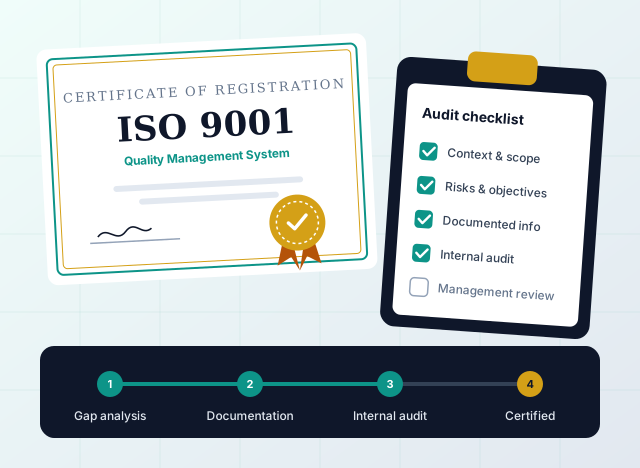
NAM QMS does not issue ISO certificates and is not a certification body. An independent accredited certification body plans the audit and issues the certificate if it decides the system meets the standard. Readiness, in our work, means the scope is agreed, the documented system matches real practice, internal audits have been run by people you trained, and management has reviewed the results. A course completion certificate from a training programme is not an ISO certificate.
Choose the standard that matches the obligation in front of you. Quality, environment, information security, occupational health and safety, and medical devices are different systems. They can share habits such as document control and management review, but they should not be treated as one product.
Five guides for organisations in Uganda
ISO 9001 certification in Uganda is the quality management route for organisations that need consistent processes and a system a customer or tender can recognise. It is the usual base when no narrower standard applies.
ISO 14001 certification in Uganda is for organisations that must show they understand their environmental aspects and legal obligations, and that they control them.
ISO 27001 certification in Uganda is for organisations that hold other people's information and need an information security management system, not a one-off IT project.
ISO 45001 for organisations covers occupational health and safety readiness, including an ISO 45001 lead auditor course for the people who will audit that system.
Preparing for ISO 13485 certification in Uganda is for organisations in the medical-device chain: design, manufacture, storage, distribution, installation or servicing. It is not a general quality badge for every hospital department.
Questions organisations ask
Is NAM QMS a certification body?
No. NAM QMS provides training and consulting for organisations. An independent accredited certification body carries out the certification audit and issues any ISO certificate. A certificate of completion from a NAM QMS course is evidence of training, not an ISO certificate.
Are these pages for individual candidates?
No. They are written for institutions and organisations that need their own staff trained and their management system prepared. Scheduled course fees are published on the course pages so a team can book seats. Personal career advice is not the offer.
What does the free ISO gap analysis include?
We look at current practice against the standard you name, and we tell you what is already covered and what still needs training, documents or records. There is no charge for that first analysis. It does not replace the certification body's audit.
Which standards can you help a Ugandan organisation prepare for?
ISO 9001, ISO 14001, ISO 27001, ISO 45001 and ISO 13485, on their own or, where the structure is shared, alongside each other. Food safety and privacy consulting remain on their own pages.
Where do we see prices?
Lead Auditor fees are on each course page. The Internal Auditor Courses page shows that programme's group fee. In-house training and consulting are quoted after the gap analysis, once the standard, the sites and the team size are known. We do not publish a single consulting price.
Can training happen at our premises?
Yes. In-house delivery is the usual route for institutions anywhere in Uganda. A Kampala venue is available when the team needs to train away from daily operations. Ask for that when you book the gap analysis or the internal-audit training.
Next step for your organisation
If your organisation is weighing ISO certification in Uganda, book the free gap analysis. We will say which standard fits and what must be true before a certification body is invited.
Book a free ISO gap analysis